Category: Housing

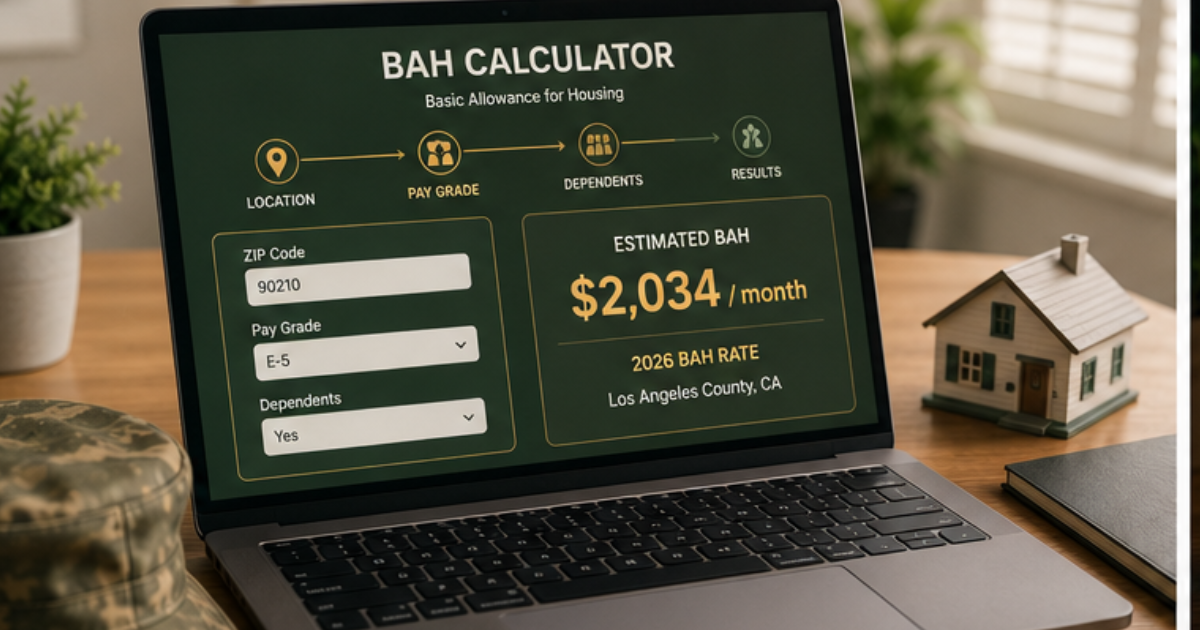
  • 2026 BAH Calculator Helps Veterans Estimate Housing Allowance More Easily

    2026 BAH Calculator Helps Veterans Estimate Housing Allowance More Easily

    Understanding housing allowance can be confusing for many veterans and military families, especially when rates vary depending on location and eligibility.

    The 2026 BAH Calculator on VA.org helps simplify this process by allowing users to estimate potential housing allowance based on factors like ZIP code, pay grade, and dependency status.

    Basic Allowance for Housing (BAH) is intended to help cover housing expenses when government housing is unavailable. For veterans using education benefits such as the Post-9/11 GI Bill, housing payments are often tied to local BAH rates.

    Housing support amounts can vary significantly between cities and states because calculations are based on local rental market conditions and military pay structures.


    The calculator helps users:

    • estimate monthly housing allowance
    • compare regional housing differences
    • understand GI Bill housing support
    • improve budgeting and financial planning
    • prepare for relocation or education expenses

    For many veterans, having a clear estimate can reduce uncertainty and make financial planning easier before moving, attending school, or changing housing arrangements.

    As housing costs continue fluctuating nationwide, tools that improve transparency and planning can help veterans make more informed financial decisions.

    The BAH Calculator provides a faster and simpler way to understand what housing support may look like before making major life decisions.


  • You Could Be Losing Thousands on Your Home Loan Without Realizing It

    You Could Be Losing Thousands on Your Home Loan Without Realizing It

    Many veterans may qualify for valuable home loan benefits but still end up paying more than necessary due to missed opportunities, higher interest rates, or limited understanding of available options.

    VA-backed home loans are designed to help eligible veterans access competitive financing with benefits that often include lower down payment requirements and reduced borrowing costs compared to traditional mortgage programs. However, not fully understanding how these loans work can result in long-term financial losses.

    Small differences in mortgage rates can create major financial impacts over the life of a loan. Even slightly higher rates may add thousands of dollars in additional payments over time.

    Common areas where veterans may lose money include:

    • accepting higher interest rates
    • missing refinancing opportunities
    • paying avoidable loan fees
    • misunderstanding eligibility advantages
    • choosing less favorable loan structures

    For many veterans, the challenge is not qualification—it’s awareness.

    Understanding how VA home loan benefits work, comparing options carefully, and reviewing financing terms can help veterans make more informed housing decisions.

    Financial experts continue encouraging borrowers to evaluate refinancing opportunities, monitor market changes, and understand all long-term costs before committing to major mortgage decisions.

    Housing remains one of the largest financial commitments for most families, which makes education and planning especially important.

    For veterans planning to purchase or refinance a home, understanding available VA housing benefits can help improve long-term financial stability and reduce unnecessary expenses.


  • VA Home Loans Wizard Helps Veterans Navigate the Home Buying Process

    VA Home Loans Wizard Helps Veterans Navigate the Home Buying Process

    Buying a home is one of the biggest financial decisions many veterans will make, but understanding the VA home loan process can sometimes feel confusing.

    From eligibility requirements to paperwork and lender preparation, there are multiple steps involved before purchasing a home.

    The VA Home Loans Wizard was designed to simplify that process.

    The tool helps veterans better understand how VA-backed home loans work and provides structured guidance to make the home buying journey easier to navigate.

    VA home loans offer several advantages compared to traditional mortgage options, including competitive rates and reduced upfront requirements for eligible veterans. Many veterans may also qualify for additional support depending on disability status and service history.

    The VA Home Loans Wizard can help veterans:

    • understand basic eligibility requirements
    • prepare for the loan process
    • identify important documentation
    • explore next steps for buying or refinancing
    • better organize home buying decisions

    One of the biggest challenges veterans face is uncertainty about where to begin.

    Having a step-by-step guide helps reduce confusion and gives veterans more confidence during the process.

    For veterans considering purchasing a home, refinancing, or exploring available housing benefits, tools like the VA Home Loans Wizard can provide a more organized starting point and improve overall understanding of available options.


  • 2026 BAH Calculator Guide: How Veterans and Service Members Can Estimate Housing Allowance

    2026 BAH Calculator Guide: How Veterans and Service Members Can Estimate Housing Allowance

    Housing costs can vary dramatically depending on where you live, which is why understanding your housing allowance is important for veterans, active-duty service members, and students using education benefits.

    The 2026 BAH Calculator on VA.org helps estimate monthly housing allowance based on location, pay grade, and dependency status. 

    Basic Allowance for Housing (BAH) is designed to help eligible military members cover housing expenses when government housing is not provided. The amount depends mainly on:

    • duty station or ZIP code
    • pay grade
    • dependency status
    • local housing market rates 

    For many veterans using the Post-9/11 GI Bill, housing payments are often referred to as “BAH,” although the VA officially calls it Monthly Housing Allowance (MHA). The amount is generally based on the Department of Defense BAH rate for an E-5 with dependents tied to the school or training location. 

    This makes estimating benefits especially important for veterans planning education, relocation, or housing expenses.

    The VA.org BAH Calculator simplifies this process by allowing users to estimate their monthly and annual housing allowance quickly using a ZIP code or city selection. 

    The calculator can help veterans:

    • estimate monthly housing support
    • compare allowance differences by location
    • understand the impact of dependency status
    • better plan budgets and living expenses
    • estimate GI Bill housing support 

    Another important factor is annual updates. BAH rates are typically adjusted each year based on housing market data, which means allowances can change depending on rental trends and local costs. 

    For veterans using GI Bill benefits, understanding rate-of-pursuit requirements and online learning rules is also important because those factors can affect housing payments. 

    Instead of guessing what your housing support might look like, tools like the 2026 BAH Calculator provide a faster and more organized way to estimate benefits before making important financial decisions.

    For veterans planning education, relocation, or future housing expenses, having a clear estimate can help reduce uncertainty and improve long-term planning.


  • VA Home Loan Wizard: A Step-by-Step Guide to Simplify Your Home Buying Journey

    VA Home Loan Wizard: A Step-by-Step Guide to Simplify Your Home Buying Journey

    Buying a home using VA benefits can be one of the most powerful financial advantages available to veterans, but the process itself can often feel confusing. From eligibility requirements to documentation and loan types, there are multiple steps involved, and missing even one detail can delay progress.

    That’s where the VA Home Loan Wizard becomes valuable.

    The VA Home Loan Wizard is designed to simplify the entire journey by guiding veterans through each stage of the process in a structured and easy-to-understand way. Instead of trying to figure everything out on your own, the tool provides direction so you know exactly what to do next.

    VA home loans themselves are backed by the Department of Veterans Affairs and offer several key benefits, including no down payment requirements, competitive interest rates, and no private mortgage insurance.  These advantages make homeownership more accessible, but understanding how to use them effectively is where most veterans struggle.

    The wizard helps break down that complexity into manageable steps.

    It can assist with understanding eligibility, identifying required documents, and preparing for the application process. For veterans who are unsure where to begin, this structured guidance removes guesswork and reduces the chances of delays.

    For those receiving disability benefits, there may be additional advantages such as exemption from certain fees and the ability to use disability income during qualification.  These factors can significantly impact affordability, and having a tool that helps clarify them makes a real difference.

    Another key benefit of using a guided tool is confidence. Instead of second-guessing decisions, veterans can move forward knowing they are following a clear path.

    The VA Home Loan Wizard is not just about information—it’s about direction.

    For veterans planning to buy, refinance, or explore housing options, having a step-by-step guide can turn a complex process into a manageable one.


  • VA Funding Fee May Be Tax-Deductible: What Veteran Borrowers Should Know

    VA Funding Fee May Be Tax-Deductible: What Veteran Borrowers Should Know

    Many Veterans who use a VA home loan focus on the benefits — no down payment, no private mortgage insurance (PMI), and competitive interest rates. But one cost that often gets overlooked is the VA funding fee.

    The good news? In certain situations, that funding fee may be tax-deductible.

    Here’s what Veterans need to understand.

    What Is the VA Funding Fee?

    The VA funding fee is a one-time charge applied to most VA home loans. It helps keep the VA loan program running and reduces costs for taxpayers. The fee amount depends on:

    • Whether it’s your first time using a VA loan

    • Your down payment amount

    • The type of loan (purchase, refinance, etc.)

    • Your military service category

    Some Veterans are exempt from paying the funding fee, including those receiving VA disability compensation or those eligible based on service-connected conditions.

    If you’re unsure about your exemption status, you can review eligibility details in our VA Home Loan guide.

    Can the Funding Fee Be Deducted on Taxes?

    In some cases, yes.

    The IRS has allowed VA funding fees to be treated similarly to mortgage insurance premiums for tax deduction purposes. When deductible, the funding fee can be included as part of your mortgage interest deduction.

    However, there are conditions:

    • Your loan must meet IRS guidelines for qualified residence interest.

    • The deduction may depend on your income level.

    • You must itemize deductions instead of taking the standard deduction.

    Tax laws can change year to year, so it’s important to consult a tax professional or review the latest IRS guidance before filing.

    How It Helps Veterans Financially

    For eligible borrowers, deducting the funding fee can reduce taxable income — which may result in a lower tax bill.

    While it may not eliminate the entire cost, it softens the impact of the upfront fee and adds another layer of value to the VA home loan benefit.

    If you’re planning to use a VA loan in 2026, understanding current limits and rules is critical. You can also review our guide on 2026 VA Home Loan Limits to see how much you may qualify to borrow.

    What Veterans Should Do Next

    If you paid a VA funding fee in the past year:

    1. Check your closing documents for the exact funding fee amount.

    2. Confirm whether you qualify for itemized deductions.

    3. Speak with a qualified tax advisor to determine eligibility.

    The VA home loan program remains one of the most powerful benefits available to service members and Veterans — and understanding every financial angle helps you maximize it.


  • 2026 VA Home Loan Limits

    2026 VA Home Loan Limits

    Buying a home with a VA loan continues to be one of the most valuable benefits available to eligible Veterans, active-duty service members, and certain military families. With each new year, updates to loan limits and housing market conditions can raise questions about how much you can borrow — and whether you still qualify for a no-down-payment mortgage.

    Understanding the 2026 VA home loan limits is important for anyone planning to buy, refinance, or upgrade their home using VA benefits.

    What Are VA Home Loan Limits?

    VA home loan limits refer to the maximum amount the Department of Veterans Affairs will guarantee for borrowers who do not have full entitlement available. These limits are tied closely to conforming loan limits established for conventional mortgages and can vary depending on the county where the property is located.

    For Veterans with full entitlement, there is typically no official loan limit — meaning you may be able to borrow above standard limits without a down payment, as long as the lender approves your credit and income qualifications.

    However, loan limits still matter in certain situations. If a borrower has used part of their entitlement on another VA loan, the remaining entitlement amount can affect how much they can finance without putting money down.

    How 2026 Loan Limits Affect Borrowing Power

    In 2026, updated loan limits reflect ongoing changes in housing prices across many regions. Higher limits can provide greater flexibility for Veterans purchasing homes in competitive markets where property values continue to rise.

    Loan limits are calculated at the county level, which means Veterans living in higher-cost areas may see significantly higher maximum amounts compared to regions with lower housing prices. Understanding your local limit helps you plan a realistic home search and avoid surprises during the loan process.

    Even though the VA itself doesn’t set strict caps for those with full entitlement, lenders still evaluate affordability based on income, debt levels, and credit history. This means your borrowing power is influenced by more than just the yearly limit numbers.

    Eligibility Rules Veterans Should Know

    To use a VA home loan in 2026, borrowers must meet basic eligibility requirements. This usually includes qualifying service history, a Certificate of Eligibility (COE), and meeting lender-specific financial guidelines.

    Key eligibility factors include:

    • Acceptable credit and income standards

    • A property that will be used as a primary residence

    • Meeting VA appraisal and property requirements

    While the VA guarantees a portion of the loan, lenders still assess risk carefully. That’s why understanding eligibility before starting the home search can make the entire process smoother.

    No Down Payment — But Not Always Zero Costs

    One of the biggest advantages of VA loans is the potential to purchase a home with no down payment. This feature remains one of the primary reasons many Veterans choose VA financing over conventional mortgages.

    However, buyers should still be prepared for other expenses, such as closing costs, funding fees, and moving-related expenses. Some of these costs may be negotiated or rolled into the loan, depending on lender policies and market conditions.

    Knowing the difference between “no down payment” and “no upfront costs” helps set realistic expectations when planning a purchase.

    Why Loan Limits Matter in Today’s Housing Market

    As housing prices shift, loan limits play a role in determining how competitive Veterans can be when making offers. Higher limits can open the door to more property options, especially in growing metropolitan areas where home values continue to increase.

    For first-time buyers, understanding these limits also helps with budgeting and long-term planning. Knowing what you may qualify for allows you to focus on homes within your financial comfort zone rather than relying solely on lender estimates later in the process.

    Final Thoughts

    The 2026 VA home loan limits reflect ongoing changes in the housing market and continue to support Veterans pursuing homeownership with flexible financing options. While many borrowers with full entitlement may not face strict borrowing caps, understanding how limits work — especially when entitlement is partially used — can make a significant difference in planning.

    By staying informed about eligibility rules, loan limits, and realistic costs, Veterans can approach the home buying process with clarity and confidence. Whether you’re purchasing your first home or exploring refinancing opportunities, knowing how the 2026 limits apply to your situation is a smart first step.


  • Am I Eligible for a VA Home Loan? A Veteran’s Guide to Checking Your Eligibility

    Am I Eligible for a VA Home Loan? A Veteran’s Guide to Checking Your Eligibility

    I’ll never forget the afternoon I found out I actually qualified for a VA home loan.

    It was a slow Saturday. My partner and I had just moved into a rental near the city where I was starting a new civilian job. We had been talking about buying a home for months — but every evening ended with more questions than answers.

    “Do we even qualify?”

    “What counts toward service time?”

    “Does active duty count differently than reserves?”

    “What if we used the benefit before?”

    We had stacks of pamphlets, PDFs, and scattered notes. Nothing made it clear. That’s when I stumbled on the VA Home Loan Eligibility Checker on VA.org.

    At first, I thought it would be another dead end. But instead it became the first moment I felt like I could actually plan a future in a home of our own.

    Why Eligibility Matters

    Using a VA home loan isn’t automatic just because you served. The benefit has powerful features — no down payment, no PMI, competitive rates, and limited closing costs — but you have to meet eligibility requirements first.

    For us, it wasn’t a question of “Do we want to own a home?” — it was “Can we?”

    That’s why checking eligibility early matters. It turns something that feels like guessing into something concrete.

    What Counts Toward Eligibility

    When I opened the eligibility tool, the first thing I learned was this: there are a few key categories that determine whether a Veteran or service member can qualify:

    1. Military Service Type

    • Active Duty

    • National Guard

    • Reserves

      Each has slightly different rules for service time and discharge conditions.

    2. Length of Service

    There’s a minimum service requirement that varies based on when and how you served.

    3. Discharge Status

    Only certain discharge types qualify — usually “honorable” or “other than dishonorable.”

    4. Remaining Entitlement

    If you used the benefit before, you may still have remaining entitlement to use it again.

    At first the list felt intimidating. But the eligibility checker turned those rules into something you could test against your own history.

    Using the VA Home Loan Eligibility Tool

    The eligibility checker itself is straightforward. You enter:

    • Your service branch

    • Your categories of service (active duty, reserves, guard)

    • Your dates of service

    • Your discharge status

    Within moments, the tool gives you a clear answer:

    Yes, you qualify

    No, you don’t (yet)

    Or sometimes: You may qualify under a different category

    For us, the answer was yes — which was a mix of relief and excitement neither of us expected. It wasn’t just numbers. This was the first time we felt like owning a home wasn’t some distant dream.

    What I Did Next

    Once I knew we were eligible, here’s what I did:

    1. Prepared My Certificate of Eligibility (COE)

    The eligibility result helped me get the COE — the document lenders require to prove I could use a VA loan.

    2. Talking to a VA-savvy Lender

    Not every lender understands the VA benefit equally. I chose one that helps Veterans every day, and that made the process smoother.

    3. Set a Budget Using BAH and Salary

    Knowing eligibility let us plan — not just fantasize — about how much house we could afford.

    4. Started Home Shopping

    With the COE in hand and confidence in our eligibility, we started house hunting.

    Each step built on the last, and it all started with knowing we were qualified.

    Common Myths Debunked

    Along the way, I learned a few things that surprised me:

    “You have to be active duty”

    No. Many National Guard and Reserve members qualify — if they meet time-in-service rules.

    “Using it once means you can never use it again”

    Wrong. You may have remaining entitlement even if you’ve used a VA loan before.

    “It takes forever to know if you qualify”

    Not with the eligibility tool. It is fast and clear — you get results in minutes.

    These myths had kept us on the sidelines for too long.

    Why You Should Check ASAP

    Despite all the excitement, the biggest lesson I learned is this:

    You can plan better when you know.

    Buying a home is a big decision. Without knowing if we even qualified, we were guessing in the dark. The eligibility checker switched the lights on.

    It gave us confidence, direction, and a first step on a journey that actually felt possible.

    Final Thoughts

    If you served and you’re thinking about owning a home — don’t wait until you think you’re ready. Start by checking your eligibility.

    The VA Home Loan Eligibility tool is easy to use, clear in its results, and it might be the very thing that turns a long-held hope into a real plan.

    For us, it wasn’t just clicking a button — it was the moment we started planning a future in a place called home.


  • How a Simple Tool Helped Me Understand My BAH — A Veteran’s Story

    How a Simple Tool Helped Me Understand My BAH — A Veteran’s Story

    I was sitting at my kitchen table, a stack of lease agreements beside me, staring at the screen of my laptop, feeling exactly like most other Veterans do at some point — confused, uncertain, and squeezed by numbers that don’t make sense.

    It was early spring, and I was getting ready to move. New job, new city, new expectations — and one thing gnawing at me more than anything: housing costs. How much could I realistically afford? How much would my Basic Allowance for Housing (BAH) actually cover? I had heard about BAH in trainings and briefings, but never truly understood how it worked in real life.

    I tried reading government pages, skimmed VA PDFs, and even asked a few friends. But nothing clicked — until I found the VA.org BAH Calculator.

    That day began a shift — not dramatic fireworks or “aha” moment, but the kind of quiet clarity that only comes when something finally makes sense.

    What BAH Is & Why It Matters

    For Veterans and service members, BAH is one of those acronyms that floats around in briefings and benefit handbooks. You know it has to do with housing, but how much? Does location matter? What about pay grade and dependents?

    Basic Allowance for Housing (BAH) is designed to help cover housing costs when you are not living in government quarters. The tricky part is that BAH isn’t one number — it changes based on:

    • Your location (ZIP code)

    • Your pay grade

    • Whether you have dependents

    That’s a lot of variables and, if you’re like me, that starts to feel like algebra without a calculator.

    Finding the VA.org BAH Calculator

    One evening, after rereading a rental agreement for the third time, I typed “how much housing allowance will I get as a Veteran” into a search bar. The first few results were confusing or outdated. Then I clicked a link — reliable, clear, labeled VA.org BAH Calculator.

    No login. No forms to fill out. No sales pitch. Just a tool with a few boxes:

    • ZIP code

    • Pay grade

    • Number of dependents

    I typed in my details and hit “Calculate.”

    Seeing the Numbers in Black & White

    Within seconds, the calculator spit out a number — not some rough guess, not “about this much,” but a clear BAH amount tied to my exact situation.

    I remember sitting back and exhaling.

    Suddenly, it wasn’t all guesswork anymore. I could see:

    • What my monthly housing allowance would be

    • How it compared to the apartments I was considering

    • Whether I needed a roommate or could go solo

    • What neighborhoods were actually realistic for my budget

    For the first time since planning this move, I felt in control.

    How I Used My BAH Estimate to Plan

    Armed with the calculator’s result, I began to make concrete decisions:

    • I narrowed my apartment search to a specific price range

    • I budgeted confidently for utilities and groceries

    • I scheduled viewings in areas close to work and within BAH coverage

    • I avoided rental options that would stretch me too thin

    Instead of guessing and hoping, I was planning with data.

    Why This Tool Helps Other Veterans Too

    The VA.org BAH Calculator isn’t just useful for someone moving to a new city — it’s helpful for:

    Budget planning

    Veterans can project income versus housing costs — before signing a lease.

    Comparing locations

    Different ZIP codes = different housing allowances. Now you can compare with real numbers.

    Family planning

    Dependents affect BAH — and long-term housing decisions.

    Career choices

    Whether relocating for a job or considering remote work, housing costs become a clear factor.

    This kind of clarity changes how you plan. It removes the vague stress of “maybe” and replaces it with the confidence of “I know.”

    Final Thoughts

    I never thought a simple online tool could make such a difference. But when you’re planning your home — your life — after service, having accurate information matters.

    The VA.org BAH Calculator didn’t just give me a number. It gave me confidence.

    It’s not glamorous. It’s not flashy. But it’s practical, clear, and Veteran-centered — and that’s exactly what helping Veterans looks like.

    If you’re planning housing, relocation, or just trying to understand your benefits more clearly — start with your BAH estimate. It may just be the first step toward a more confident plan.


  • Best Home Warranty Companies for Veterans – Discounts & Coverage Options

    Best Home Warranty Companies for Veterans – Discounts & Coverage Options

    Homeownership comes with pride — and unexpected expenses. For Veterans, especially those purchasing homes through VA loans, home warranties can provide financial protection against sudden repair or replacement costs for essential systems and appliances.

    While home warranties are optional, many Veterans consider them a practical layer of protection, particularly during the first year of ownership or when buying older homes.

    What Is a Home Warranty?

    A home warranty is a service contract that helps cover the cost of repairing or replacing major home systems and appliances due to normal wear and tear. This typically includes:

    • Heating and cooling systems

    • Plumbing and electrical systems

    • Water heaters

    • Kitchen appliances

    Unlike homeowners insurance, warranties focus on mechanical breakdowns, not natural disasters.

    Why Veterans Consider Home Warranties

    Veterans often choose home warranties to:

    • Reduce unexpected repair expenses

    • Protect limited or fixed incomes

    • Gain peace of mind after purchasing a home

    • Avoid large upfront repair bills

    Some sellers include a home warranty during a VA loan transaction, particularly in competitive markets.

    Veteran Discounts and Military Pricing

    Some home warranty companies offer:

    • Military appreciation discounts

    • Reduced annual premiums for Veterans

    • Promotional pricing for service members

    These discounts are not always advertised, so Veterans should ask directly when requesting quotes.

    What Veterans Should Look for in a Warranty Plan

    Key considerations include:

    • Coverage limits per system

    • Exclusions and waiting periods

    • Service call fees

    • Contractor response times

    The “best” plan depends on the home’s age, location, and existing systems.

    Are Home Warranties Worth It?

    Home warranties are not necessary for every homeowner. Veterans should weigh:

    • Age and condition of home systems

    • Available emergency savings

    • Comfort with repair risks

    For some, warranties offer valuable financial predictability.

    Final Thoughts

    Home warranties can be a useful tool for Veterans seeking to manage repair risk responsibly. The key is understanding coverage details, avoiding assumptions, and choosing plans aligned with real household needs.