Blog

  • Spiritual Care Programs Continue Supporting Homeless Veterans Beyond Housing

    Spiritual Care Programs Continue Supporting Homeless Veterans Beyond Housing

    Support programs for homeless and formerly unhoused veterans continue evolving beyond housing assistance by focusing more closely on emotional wellness, connection, and long-term recovery support.

    Spiritual care initiatives are becoming an increasingly important part of helping veterans rebuild stability and improve overall wellbeing. 

    Programs connected to veteran housing support efforts often recognize that recovery involves more than simply providing shelter. Emotional support, purpose, relationships, and personal connection also play important roles in long-term wellbeing.

    Research surrounding veteran housing programs has highlighted how spiritual support and community engagement may help improve quality of life for veterans transitioning out of homelessness. 

    Spiritual care support may include:

    • counseling and chaplain services
    • emotional wellness support
    • peer connection programs
    • community-building activities
    • grief and trauma support
    • wellness and recovery guidance

    Community organizations and veteran programs continue exploring ways to provide more holistic support systems that address both practical and emotional challenges.

    For some veterans, spiritual care may help restore a sense of meaning, dignity, and personal connection during difficult transitions.

    Healthcare and support professionals increasingly recognize that long-term recovery often requires attention to emotional and social wellbeing alongside housing and financial assistance.

    As more veteran-focused organizations expand holistic support programs, spiritual care continues becoming an important part of broader veteran wellness initiatives.


  • Women Veterans: VA Outreach and Support Services Are Expanding Nationwide

    Women Veterans: VA Outreach and Support Services Are Expanding Nationwide

    The Department of Veterans Affairs continues expanding outreach efforts aimed at improving access to healthcare, benefits, and support services for women veterans across the country. New regional initiatives and community events are designed to help more women veterans connect directly with available resources and programs. 

    As the number of women veterans continues growing nationwide, the VA has increased focus on ensuring services are more accessible, visible, and responsive to their needs.

    Outreach programs are intended to improve awareness about available healthcare services, mental health resources, education support, maternity care, benefits guidance, and community assistance programs.

    Many women veterans may not realize the full range of services available to them or may face challenges navigating systems after military service.

    Current outreach efforts may include:

    • regional veteran summits
    • healthcare education events
    • women veteran support programs
    • community resource connections
    • benefits awareness initiatives
    • wellness and mental health support 

    The VA has emphasized that improving outreach is an important part of ensuring women veterans feel recognized, informed, and supported throughout their post-service journey.

    Community events and regional programs also create opportunities for women veterans to connect with other veterans, organizations, and support networks.

    As services continue expanding, outreach efforts aim to bring more personalized support directly into local communities instead of expecting veterans to navigate everything alone.

    For many women veterans, increased visibility and easier access to information can make a meaningful difference in long-term wellbeing and healthcare engagement.


  • Job Search Tips for New Graduates Entering Today’s Competitive Market

    Job Search Tips for New Graduates Entering Today’s Competitive Market

    Entering the job market as a new graduate can feel challenging, especially in today’s highly competitive hiring environment. Career experts continue encouraging graduates to focus on adaptability, practical experience, networking, and skill development to improve job opportunities in 2026. 

    The hiring landscape has changed significantly in recent years. Many entry-level roles are becoming more competitive, while employers increasingly look for candidates who can demonstrate practical skills, flexibility, and the ability to learn quickly.

    Networking remains one of the most important tools for new graduates. Building professional relationships through internships, LinkedIn connections, alumni networks, and career events can often create opportunities beyond standard online applications. 

    Experts also recommend focusing on transferable skills and real-world experience instead of relying only on academic achievements.

    Important job search strategies may include:

    • building a strong resume and online profile
    • developing AI and digital skills
    • applying strategically instead of mass applying
    • networking consistently
    • creating portfolios or project examples
    • staying flexible about entry-level opportunities 

    Many employers now expect graduates to understand AI-assisted tools and modern workplace technology, even in non-technical roles. Demonstrating adaptability and willingness to learn can help candidates stand out.

    Career experts also encourage graduates to remain patient during the hiring process, as recruitment timelines may take longer than expected in some industries.

    For veterans transitioning into civilian careers, these strategies can be especially valuable when translating military experience into professional opportunities.

    The most successful job searches often combine preparation, persistence, and continuous skill improvement.


  • VA Hospitals Earn Record-High Quality Ratings in 2026 CMS Report

    VA Hospitals Earn Record-High Quality Ratings in 2026 CMS Report

    The Department of Veterans Affairs has announced record-high hospital quality ratings in the latest 2026 report released by the Centers for Medicare & Medicaid Services (CMS). According to the report, 78% of VA hospitals receiving an Overall Hospital Quality Star Rating earned four or five stars, marking one of the strongest performances in recent years. 

    The ratings are based on several key healthcare quality categories, including patient safety, mortality, readmission rates, patient experience, and effectiveness of care. A higher star rating reflects stronger overall hospital performance and patient outcomes. 

    The latest results continue a positive trend for VA healthcare systems. Officials noted that this is the second consecutive year in which no VA hospital received a one-star rating, while a large majority maintained or improved their previous ratings. 

    The report also highlights how VA hospitals continue outperforming many non-VA healthcare facilities in several patient care categories.

    Areas contributing to stronger ratings include:

    • improved patient experience
    • enhanced safety standards
    • better care coordination
    • faster treatment access
    • stronger healthcare outcomes

    The VA has continued investing in healthcare modernization, infrastructure upgrades, and digital health systems aimed at improving veteran care experiences nationwide. 

    For veterans and families, these ratings provide additional confidence when evaluating healthcare options and accessing VA medical services.

    As healthcare expectations continue evolving, maintaining strong quality standards remains an important focus for veteran healthcare systems across the country.


  • VA Home Loans Wizard Helps Veterans Navigate the Home Buying Process

    VA Home Loans Wizard Helps Veterans Navigate the Home Buying Process

    Buying a home is one of the biggest financial decisions many veterans will make, but understanding the VA home loan process can sometimes feel confusing.

    From eligibility requirements to paperwork and lender preparation, there are multiple steps involved before purchasing a home.

    The VA Home Loans Wizard was designed to simplify that process.

    The tool helps veterans better understand how VA-backed home loans work and provides structured guidance to make the home buying journey easier to navigate.

    VA home loans offer several advantages compared to traditional mortgage options, including competitive rates and reduced upfront requirements for eligible veterans. Many veterans may also qualify for additional support depending on disability status and service history.

    The VA Home Loans Wizard can help veterans:

    • understand basic eligibility requirements
    • prepare for the loan process
    • identify important documentation
    • explore next steps for buying or refinancing
    • better organize home buying decisions

    One of the biggest challenges veterans face is uncertainty about where to begin.

    Having a step-by-step guide helps reduce confusion and gives veterans more confidence during the process.

    For veterans considering purchasing a home, refinancing, or exploring available housing benefits, tools like the VA Home Loans Wizard can provide a more organized starting point and improve overall understanding of available options.


  • Meet AI Joe: The AI-Powered Veteran Specialist Available 24/7

    Meet AI Joe: The AI-Powered Veteran Specialist Available 24/7

    Finding answers about VA benefits and veteran services can often feel overwhelming, especially when veterans are dealing with disability claims, healthcare questions, education benefits, or housing concerns at the same time.

    AI Joe was created to simplify that experience.

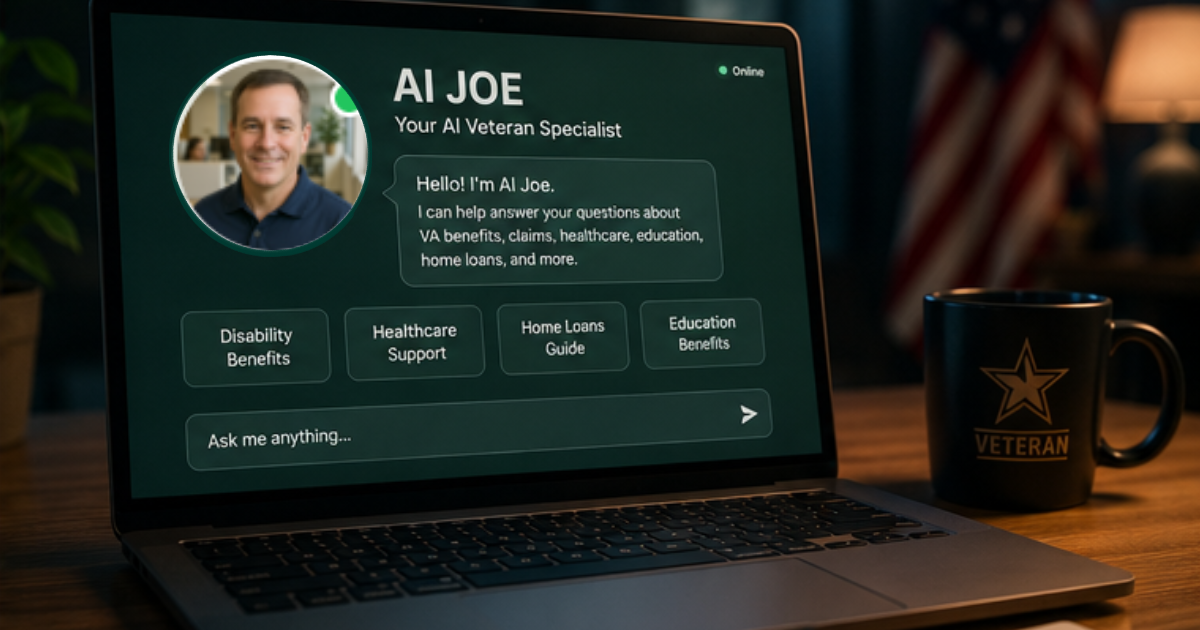
    AI Joe is an AI-powered veteran support assistant available through VA.org that helps veterans get faster answers to common questions related to benefits, healthcare, disability ratings, education programs, home loans, and more.

    Instead of searching through multiple websites or trying to understand complicated documents, veterans can ask questions directly and receive easy-to-understand guidance in real time.

    The goal is not to replace professional support services, but to improve access to information and reduce confusion.

    AI Joe can help veterans:

    • understand benefit-related questions
    • learn about disability support tools
    • explore VA home loan guidance
    • find forms and educational resources
    • receive quick informational support 24/7

    One of the biggest advantages is accessibility. Veterans can use AI Joe anytime without waiting for office hours or callbacks.

    For many veterans, getting quick guidance helps reduce stress and improves confidence when navigating complex systems.

    As digital tools continue evolving, AI-powered support assistants like AI Joe are helping make veteran support faster, simpler, and easier to access.


  • Stronger Together: Veterans Encouraged to Join 250 Million Acts of Kindness Campaign

    Stronger Together: Veterans Encouraged to Join 250 Million Acts of Kindness Campaign

    A nationwide community initiative is encouraging Americans to come together through service, volunteering, and everyday acts of kindness as the country approaches its 250th anniversary. Veterans are being encouraged to take part in the movement and help lead efforts within local communities. 

    The campaign centers around a simple idea: small actions can create meaningful impact. Organizers are calling for 250 million acts of kindness across the country through volunteer work, neighbor support, and community engagement activities. 

    Suggested activities include:

    • helping local shelters
    • supporting senior centers
    • participating in food drives
    • neighborhood cleanups
    • assisting military families
    • volunteering within local communities

    Veterans are uniquely positioned to support these efforts because service, teamwork, and community involvement are already deeply connected to military experience.

    For many veterans, community service can also help restore a sense of mission and connection after military service ends.

    The initiative encourages individuals, organizations, nonprofits, businesses, and community leaders to participate together in building stronger neighborhoods through simple positive actions. 

    As more organizations and volunteers join the campaign, the message remains focused on unity, compassion, and supporting one another through everyday acts of service.

    Even small acts of kindness can help strengthen communities and create a more connected environment for veterans, families, and neighbors alike.


  • Veteran Receives Next-Generation Eye Care Through VA Telehealth Services

    Veteran Receives Next-Generation Eye Care Through VA Telehealth Services

    Advanced telehealth technology is helping improve eye care access for veterans, especially those living in rural areas or far from major medical centers. A recent VA healthcare success story highlighted how modern eye care systems are making appointments faster, more convenient, and less stressful for veterans. 

    The updated care approach uses advanced imaging equipment and tele-eye care services that allow specialists to review eye health remotely without requiring veterans to travel long distances for every appointment.

    In one recent case, a veteran receiving care through the VA experienced a more streamlined eye examination process that reduced the need for traditional eye dilation procedures while still providing high-quality monitoring and treatment planning. 

    The VA’s Technology-Based Eye Care Services (TECS) program has been expanding access to vision care for veterans through remote screening, virtual consultations, and digital imaging support. These services help improve accessibility while reducing travel burdens for veterans in underserved communities. 

    Tele-eye care services can support:

    • routine vision exams
    • diabetic eye screenings
    • eyeglass prescriptions
    • monitoring of eye conditions
    • specialty vision consultations
    • rehabilitation support for low vision care 

    Programs like these are part of the VA’s broader effort to modernize healthcare delivery and improve convenience for veterans through digital health technology.

    For veterans who face mobility challenges, live in rural areas, or simply want easier access to care, virtual eye care services can significantly reduce delays and improve overall healthcare experiences.

    As telehealth technology continues expanding, eye care is becoming one of the many healthcare areas benefiting from faster, smarter, and more connected systems.


  • VA Benefits Scorecard: A Smarter Way for Veterans to Understand Their Benefits

    VA Benefits Scorecard: A Smarter Way for Veterans to Understand Their Benefits

    Many veterans know they have benefits available, but not everyone fully understands what they currently qualify for or where gaps may exist.

    The VA Benefits Scorecard is designed to help veterans gain a clearer overview of their benefits position in a simple and organized way.

    Understanding benefits can sometimes feel overwhelming because multiple programs, ratings, eligibility requirements, and support systems may apply at the same time.

    The scorecard helps simplify that experience by offering a structured overview that encourages veterans to better understand their current situation.

    Potential areas covered may include:

    • disability-related benefits
    • education and GI Bill support
    • healthcare eligibility
    • housing-related assistance
    • overall benefits awareness

    For many veterans, uncertainty creates hesitation. They may not know whether they qualify for certain programs or whether their current benefits fully reflect their needs.

    A scorecard approach provides a starting point for understanding where things stand.

    This can help veterans feel more informed before making decisions related to claims, healthcare, education, or future planning.

    The goal is not just information—it’s clarity.

    By helping veterans better understand their benefits picture, tools like the VA Benefits Scorecard can reduce confusion and encourage more confident decision-making.


  • VA Disability Rating Estimator: How Veterans Can Better Understand Their Benefits

    VA Disability Rating Estimator: How Veterans Can Better Understand Their Benefits

    Understanding VA disability ratings can be confusing for many veterans, especially when multiple conditions, percentages, and compensation factors are involved.

    The VA Disability Rating Estimator helps simplify that process by giving veterans a clearer idea of how disability percentages may impact benefits and compensation. 

    A disability rating is used by the Department of Veterans Affairs to determine the severity of service-connected conditions and calculate compensation eligibility. Ratings typically range from 0% to 100%, and even small percentage changes can significantly affect monthly payments and additional benefits.

    Many veterans are unsure whether their current rating accurately reflects their condition. Others may not understand how combined ratings work when multiple conditions are involved.

    This is where estimation tools become useful.

    The estimator provides veterans with a more organized way to explore possible ratings and understand how certain conditions may affect overall compensation.

    Benefits of using the estimator may include:

    • clearer understanding of disability percentages
    • improved awareness of compensation levels
    • better preparation before filing claims
    • increased confidence during benefit planning
    • easier understanding of combined ratings

    For many veterans, the biggest challenge is uncertainty. Having access to educational tools and estimates can reduce confusion and help veterans make more informed decisions regarding their benefits.

    The estimator is not intended to replace official VA decisions, but it can serve as a helpful starting point for veterans seeking clarity about their disability benefits.